WhatsApp and Excel run a lot of good businesses - until they quietly start costing you time, money and customers. Here are the signs it's time for a platform.
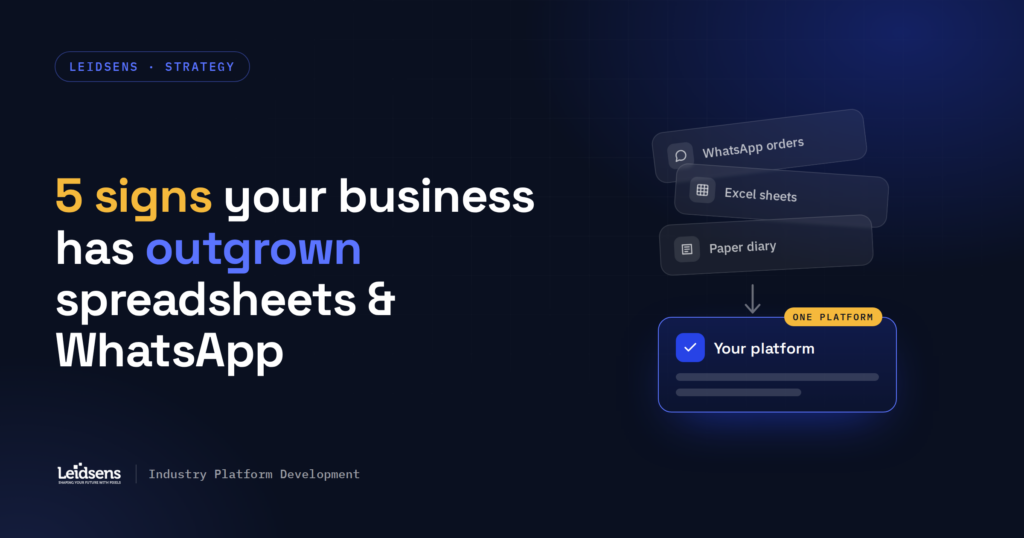
Plenty of good businesses in India run on WhatsApp, a couple of Excel sheets and one or two apps. For a while, that stack is perfect: it is cheap, everyone knows how to use it, and it gets the job done. The trouble is that it keeps “getting the job done” long after it has quietly started costing you – in time, in money, and in customers you never realise you lost.
We build and run our own platforms, so we see this pattern constantly: the tools that help a business start are often the same ones holding it back a few years later. Here are five signs you have reached that point.
A customer messages on WhatsApp. You note it in a diary. You copy it into Excel. You raise a bill in a separate app. The same detail – a name, an order, an appointment – gets entered three or four times. Every re-entry is time lost and a chance to make a mistake. When your day is full of copy-paste between tools, those tools are working against each other, not together.
Where is the full history of this customer? Part of it is in chat, part in a spreadsheet, part in someone’s head. When a regular calls, you cannot instantly see what they bought last time, what they owe, or what they asked for. That scattered memory is fine with ten customers. At a few hundred it means slower service and missed opportunities – and it all falls apart the day a key staff member leaves and takes their “system” with them.
Follow-ups that never happen. Double bookings. An order confirmed on chat but never fulfilled. A patient who was meant to return but never got a reminder. None of these are anyone’s fault – they are the natural result of a process held together by memory and manual effort. A real platform does the remembering for you: reminders, statuses and follow-ups happen automatically instead of depending on someone noticing.
How many orders did we do last month? Which service earns the most? Who has not paid? If answering these means opening five chats and a spreadsheet – or you simply cannot answer them at all – you are flying blind. You cannot improve what you cannot see. When your numbers live in one place, decisions stop being guesswork.
The tools that help a business start are often the same ones holding it back a few years later.
This is the clearest sign of all. With a good system, more customers should feel easier – just more of the same smooth process. If instead every new customer adds stress, more manual work and more chances for something to go wrong, your operations do not scale. You have hit the ceiling of what spreadsheets and chat can carry.
There is often a quieter cost too. If you depend on an aggregator or marketplace to bring you customers, you may be paying a commission on every sale – for a customer relationship you do not actually own. Growing on someone else’s platform can mean growing their business as much as your own.
A platform is not a fancier website. It is the software your business actually runs on – one connected system where bookings, customers, orders, billing and follow-ups all live together and talk to each other. Enter something once, and it flows everywhere it is needed. Your data, your customers and your history belong to you. And instead of paying per transaction to a middleman, you run on infrastructure you own.
The worry is understandable: changing the system that runs your business feels risky. It does not have to be a leap. Two things keep it safe:
That prototype-first approach is exactly how we build our own platforms, and how we build them for clients. If two or three of the signs above sound familiar, it is worth costing out what owning your platform would look like.
If you would like to see what that could mean for your business, book a 30-minute call – we will map your workflow and show you what a platform for your industry could do, with no obligation.
Book a 30-minute call and see how we would approach it - no obligation.
GoTripBroker connects travellers, verified agents and homestay owners on one bidding platform - with secure, OTP-verified registration for every account. Here's how…
Read →Aggregators bring new customers - and take a slice of every order, plus the customer. Here's what direct, commission-free ordering changes, and…
Read →A website tells; a platform does. Here's the simple test, the signs you only need a website, the signs you need a…
Read →