Commission, fulfilment, ads, returns - marketplace deductions add up, and the customer never becomes yours. What owning your ecommerce platform means for an Indian brand.
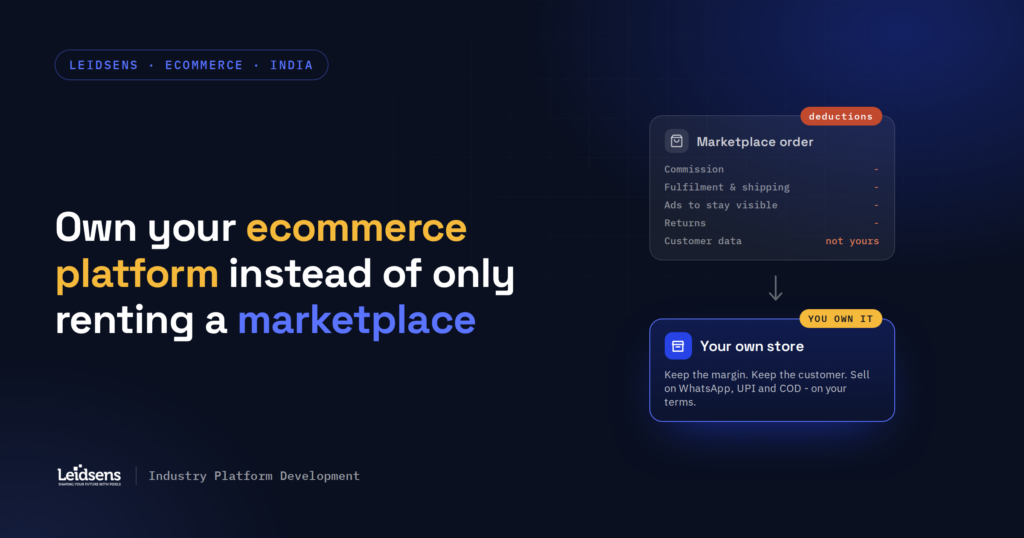
If you sell online in India, the default path is obvious: list on Amazon or Flipkart, maybe open a Meesho or JioMart account, and let the marketplace bring the buyers. It works – until you look closely at what each order actually leaves you with. For a growing Indian brand, the question isn’t whether marketplaces are useful. It’s whether they should be the only place you sell.
We build LeidKart, a commerce platform for brands who want to own their store, so here’s the honest picture – specifically for Indian sellers.
The commission is only the headline. On a typical Indian marketplace order, the deductions stack up:
Add these together and the gap between your listed price and what actually lands in your bank account is far wider than the commission percentage suggests. Work out your own number per order before you decide anything – most sellers are surprised.
The bigger loss is strategic, and it never appears in a settlement report: the customer isn’t yours.
You don’t get their phone number or email. You can’t message them when you launch something new. You can’t reward them for coming back. The marketplace built that relationship – you just fulfilled the order. So every festive sale you win is a customer you have to re-acquire, at full cost, the next time.
On a marketplace you rent the customer. On your own store you keep them.
You’re also selling beside your own competitors – and often beside cheaper copies of your own product – on a page where the platform decides who gets seen.
It would be easy – and wrong – to tell you to shut your Amazon account. Marketplaces solve the hardest problem in commerce: discovery. Millions of buyers are already there, they trust the platform’s delivery and returns, and for a new brand with no audience, that traffic is genuinely worth paying for.
The mistake isn’t using marketplaces. It’s using only marketplaces – staying a permanent tenant when you could also be building something you own.
The brands that build real value do both deliberately:
Every repeat order that shifts from the marketplace to your own store is full margin instead of a fraction, and a customer you now own. Do that consistently and your store quietly becomes your most profitable channel.
The old reason to avoid this was effort – building and running a store felt like a big technology project. It isn’t anymore. A modern platform gives you catalogue, cart, payments, orders and GST-ready invoicing out of the box, integrates with Indian payment and shipping partners, and can meet buyers on WhatsApp instead of asking them to learn a new app. That’s exactly why we built LeidKart with a WhatsApp storefront alongside the web store.
For a deeper look at the trade-offs, read our related piece on owning your store vs. renting a marketplace.
If marketplace deductions are eating your margin and you’d like to see what owning your channel would look like, book a 30-minute call – we’ll map how you sell today and where owning your store would pay off, with no obligation.
Book a 30-minute call and see how we would approach it - no obligation.
GoTripBroker connects travellers, verified agents and homestay owners on one bidding platform - with secure, OTP-verified registration for every account. Here's how…
Read →Aggregators bring new customers - and take a slice of every order, plus the customer. Here's what direct, commission-free ordering changes, and…
Read →A website tells; a platform does. Here's the simple test, the signs you only need a website, the signs you need a…
Read →