Aggregators bring new customers - and take a slice of every order, plus the customer. Here's what direct, commission-free ordering changes, and how to run both.
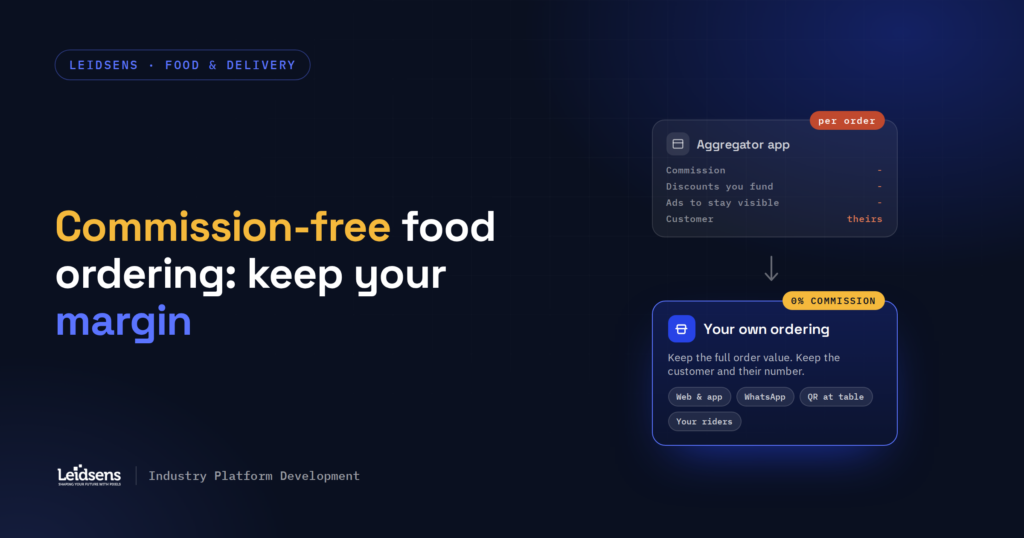
Ask most restaurant owners in India what their biggest cost is after rent and staff, and you’ll get an unexpected answer: the delivery apps. Aggregators bring you orders you might never have got — but they take a slice of every one, they own the customer, and they set the rules. Commission-free ordering is the alternative: your own ordering channel, where the order is yours and so is the margin.
This isn’t an argument to delete your aggregator accounts. It’s an argument to stop making them the only way people can order from you.
The commission is the visible cost. The rest of it isn’t:
Do the arithmetic on your own numbers before you decide anything: take a typical order, subtract commission, your share of the discount, packaging and the promotion cost, and see what’s left. Most owners have never done that calculation, and it’s usually sobering.
It means customers order directly from you — through your own site, your own app, a WhatsApp link, or a QR code on the table — and the whole order value lands with you. You pay for the software, not a percentage of every dish.
Aggregators are a customer-acquisition channel. They shouldn’t be your ordering system.
The difference compounds. A flat platform cost gets cheaper per order the busier you get. A commission does the opposite: the more successful you are, the more you pay, forever.
Commission is the money you can see. The relationship is the money you can’t.
When someone orders directly, you get their number and their order history. That means you can bring them back — a message when their favourite dish returns, a Diwali offer, a loyalty reward, a reason to reorder on a slow Tuesday. On an aggregator, the customer belongs to the app, and it will happily recommend the restaurant next door tomorrow.
Repeat customers are the whole game in food. Owning them is what turns a busy month into a durable business.
Here’s the part most “ditch the apps” advice skips. Aggregators genuinely solve something hard: new customers. Millions of hungry people open those apps every evening with no particular restaurant in mind. A brand-new kitchen with no following can get orders from day one — and that’s worth paying for.
So the answer isn’t to walk away. It’s to stop letting a discovery channel own your repeat business.
Restaurants that get this right run both, deliberately:
Every repeat customer who shifts from the app to your own channel is full margin instead of a fraction — and a customer you keep.
Owning ordering is not the technology project it used to be. A workable setup needs:
That’s the platform we build for restaurant clients as a custom enterprise solution: branded ordering, kitchen display, rider dispatch and live tracking — owned entirely by the restaurant, with no commission on any order.
Don’t try to move every customer at once. Start with the ones who already love you: your regulars, your takeaway counter, your table diners. Give them a direct way to order and a small reason to use it. Once that channel is working and orders are flowing, widen it. The apps keep bringing new faces; your channel keeps them.
If commissions are eating a restaurant that’s otherwise doing well, it’s worth seeing what owning your ordering would change. Book a 30-minute call and we’ll map how orders reach you today and where a commission-free channel would pay off — with no obligation.
Book a 30-minute call and see how we would approach it - no obligation.
GoTripBroker connects travellers, verified agents and homestay owners on one bidding platform - with secure, OTP-verified registration for every account. Here's how…
Read →A website tells; a platform does. Here's the simple test, the signs you only need a website, the signs you need a…
Read →A practical guide for Indian clinics: what clinic software should cover, the six questions to ask before you buy, and what online…
Read →