A website tells; a platform does. Here's the simple test, the signs you only need a website, the signs you need a platform - and the costly mistake both ways.
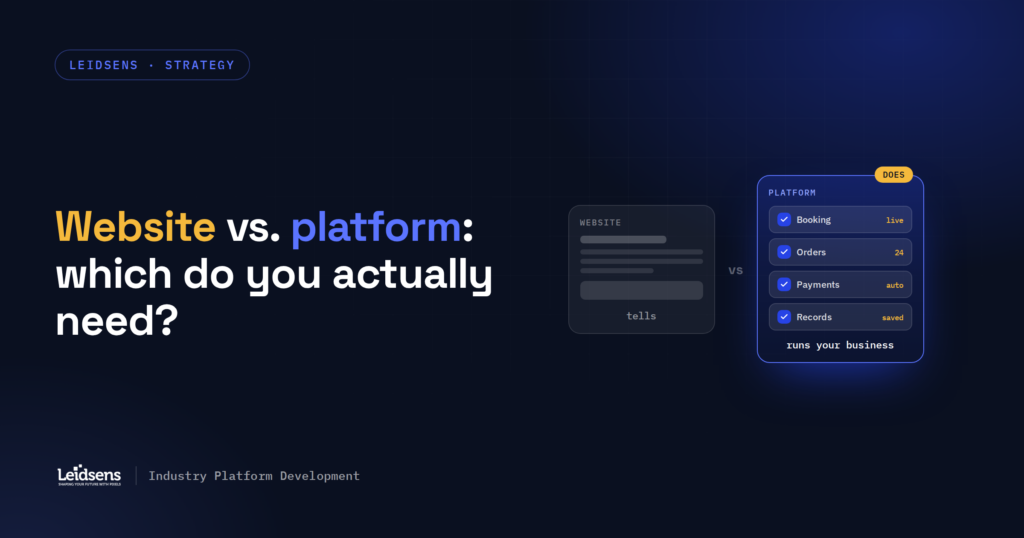
“We need a website.” It’s how almost every conversation starts — and about half the time, it’s not what the business actually needs. What they describe next is bookings, orders, customer records, staff logins, invoices. That isn’t a website. That’s a platform. The two get talked about as if they’re the same thing, and choosing the wrong one is an expensive mistake in both directions.
Here’s the difference in plain terms, and how to tell which one your business needs.
A website is where people learn about you. It presents information — who you are, what you offer, how to get in touch. It’s essentially a brochure that lives online. Visitors read it, maybe fill in a contact form, and leave.
A platform is where work happens. People log in and do things — book an appointment, place an order, upload a document, check their history, pay an invoice. Your staff use it too. It holds data, enforces rules, and runs a process from start to finish.
If your business could keep running with the site switched off, it’s a website. If the business stops, it’s a platform.
That single test settles most cases. A restaurant’s menu page? Website. The system taking the orders, routing them to the kitchen and dispatching a rider? Platform.
Let’s be honest — plenty of businesses genuinely don’t need a platform, and selling them one would be wrong:
If that’s you, build a good website. It’s cheaper, faster and completely sufficient. Don’t let anyone talk you into more.
Two or more of these, and a website will not solve your problem. You’ll build it, feel good for a month, and still be running the business out of WhatsApp.
Businesses get this wrong two ways, and both cost real money.
Building a website when you needed a platform. This is the common one. You spend on a beautiful site, launch it, and nothing about your actual operations changes — because the site was never going to take bookings, stop double-entry, or cut your no-shows. The money isn’t wasted exactly, but the problem you were trying to solve is still there.
Building a platform when a website would do. Rarer, but painful — a large build, a long timeline, and complexity you don’t need, to solve a problem you didn’t have. Good builders should tell you when you’re in this position. We do.
Fair question. A website with a plugin can absolutely handle simple cases — a single calendar, a contact form, a basic shop. The line gets crossed when your process has real rules: multiple doctors with different schedules, vendors bidding on requests, batch and expiry tracking, tiered pricing per customer, staff roles and approvals. At that point you’re bolting business logic onto something that was designed to display pages, and it gets fragile fast.
A useful rule: if you’re fighting the tool to make your process fit, you’ve outgrown the website.
The good news is this decision doesn’t require a leap of faith. The way we handle it is prototype-first: before any production code, we build a working, clickable version of the platform so you can use it and see exactly what you’d be getting. If it turns out a simpler solution serves you, that’s a much better time to find out than after the build.
If you’re not sure which side of the line you’re on, that’s a normal place to be — and worth 30 minutes. Book a call and we’ll map how your business actually runs, and tell you honestly whether you need a website, a platform, or something in between.
Book a 30-minute call and see how we would approach it - no obligation.
GoTripBroker connects travellers, verified agents and homestay owners on one bidding platform - with secure, OTP-verified registration for every account. Here's how…
Read →Aggregators bring new customers - and take a slice of every order, plus the customer. Here's what direct, commission-free ordering changes, and…
Read →A practical guide for Indian clinics: what clinic software should cover, the six questions to ask before you buy, and what online…
Read →