Marketplaces bring instant reach; your own store keeps the margin, the customer and the brand. Here are the real trade-offs - and why smart brands do both.
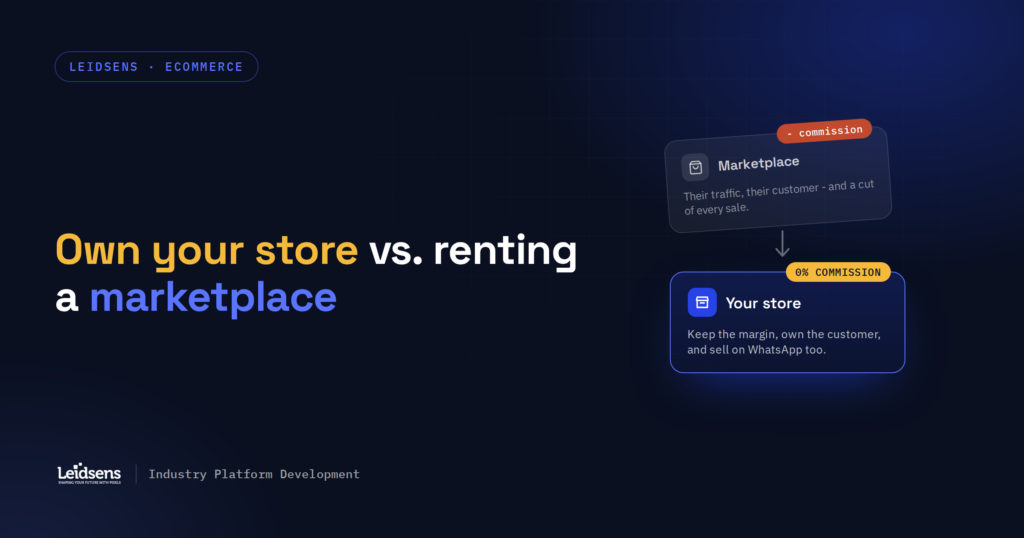
Every online seller faces the same fork in the road: sell on a big marketplace, or build your own store. Marketplaces promise instant reach; your own store promises ownership. Both are real – and the honest answer for most brands isn’t “pick one,” it’s knowing what each actually costs you and using them in the right order.
We build LeidKart, a commerce platform that lets brands own their store and sell on WhatsApp, so this is a trade-off we live with. Here it is without the hype.
A marketplace gives you something valuable and hard to build: traffic. Millions of buyers are already there. But you rent that reach, and the rent is steep in ways that aren’t obvious on day one.
Your own store flips every one of those. It’s harder to get traffic at first, but what you build is yours.
On a marketplace you rent an audience. With your own store you build an asset.
Owning a store is not automatically better, and pretending otherwise would be dishonest. For a brand-new seller with no audience, a marketplace’s traffic is genuinely valuable – getting discovered is the hardest problem, and paying commission to be found can be worth it early. Marketplaces also suit pure commodity products where brand barely matters, and they’re a fast way to test whether a product sells at all before you invest in a store. The mistake is treating that as your permanent home.
This isn’t really “own vs rent” – it’s sequence and mix. The brands that do best use a marketplace for what it’s good at (discovery) and their own store for what it’s good at (margin, data, loyalty), and they deliberately move customers from the first to the second.
Practically: list on the marketplace to get found, but put your brand – an insert, a QR code, an offer – in every order that gives the buyer a reason to visit your own store next time. Each repeat purchase that happens on your store instead of the marketplace is full margin and a customer you now own.
The old objection to owning your store was effort – it was a project. It isn’t anymore. A modern commerce platform gives you catalogue, cart, payments and orders out of the box, and it can meet customers where they already are. That’s why we built LeidKart with a conversational WhatsApp storefront alongside the web store: your customers can browse and order in the app they already use all day, on a store you own.
If you’re selling on marketplaces and watching commissions climb, it’s worth seeing what owning your store – and your customers – would look like. Book a 30-minute call and we’ll map how you sell today and where owning your channel would pay off, with no obligation.
Book a 30-minute call and see how we would approach it - no obligation.
GoTripBroker connects travellers, verified agents and homestay owners on one bidding platform - with secure, OTP-verified registration for every account. Here's how…
Read →Aggregators bring new customers - and take a slice of every order, plus the customer. Here's what direct, commission-free ordering changes, and…
Read →A website tells; a platform does. Here's the simple test, the signs you only need a website, the signs you need a…
Read →